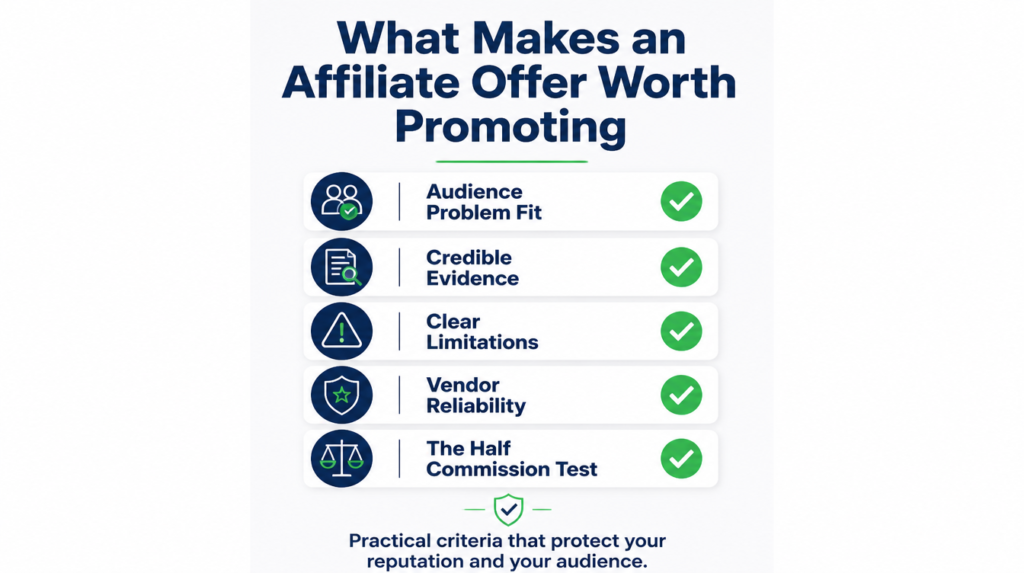
Answer: An affiliate offer is worth promoting when it solves a real problem for your audience, delivers enough value to justify the price and effort, comes from a reliable vendor, supports its claims with credible evidence, and provides a customer experience you are willing to stand behind. The affiliate program must also track referrals reliably and offer fair commercial terms.
The commission matters, but it is not the deciding factor. A high-paying offer can still damage your credibility if the product is weak, the vendor treats customers poorly, or the recommendation does not fit your audience. A lower-paying offer may be worth more to your business over time if buyers use it successfully and continue trusting your judgment.
The standard should not be whether an offer is available to promote. The standard should be whether it deserves your recommendation.
It Solves a Problem Your Audience Actually Has
An affiliate offer becomes worth considering when it addresses a problem your audience already recognizes and wants to solve.
This sounds obvious, but many promotions begin with the product rather than the audience. The affiliate finds an attractive program, reviews the payout, and then searches for an angle that makes the offer appear relevant. That approach often creates recommendations that feel forced because the product did not grow naturally from an audience need.
A stronger process begins by identifying what the audience is trying to accomplish now. The offer should connect directly to that problem and feel like a reasonable next step in the buyer’s path.
If your audience is trying to create content more consistently, a practical planning tool or publishing system may fit naturally. Advanced attribution software may be useful later, but it may not belong in front of people who are still struggling to publish their first few pieces of content.
The right offer meets the audience where they are rather than asking them to become a different audience before the product makes sense.
For a deeper fit test, read how to know if an affiliate offer is right for your audience.
The Product Delivers Meaningful Value
An offer is not worth promoting merely because it contains a large number of features, modules, templates, bonuses, or training hours. What matters is whether those elements help the buyer make meaningful progress.
Product value should be evaluated in relation to the problem being solved. A simple product can be extremely valuable when it removes a specific obstacle quickly. A complicated product can feel disappointing when the buyer needs weeks of setup before receiving any benefit.
Look beyond what the product includes and consider what the right buyer can realistically accomplish with it. The product should reduce difficulty, save time, improve a process, clarify a decision, or help the buyer achieve an outcome that matters.
The value should also justify the total commitment. That includes the price, implementation time, learning curve, supporting tools, additional subscriptions, and ongoing effort required to use the product successfully.
A product becomes easier to recommend when the expected benefit clearly outweighs the full cost of receiving it.
The Product Supports Its Claims
A worthwhile affiliate offer should provide credible support for its major promises.
If the product claims to save time, improve conversions, simplify a complicated process, help beginners, or produce a particular outcome, there should be evidence that makes those claims easier to evaluate. This evidence may include demonstrations, customer examples, case studies, documentation, screenshots, independent feedback, or firsthand use.
The proof should connect directly to the claim. A collection of vague testimonials may create a positive impression without showing whether the product delivers the specific result being advertised.
You should also examine the conditions behind the evidence. A result may depend on technical skills, existing traffic, advertising spend, prior experience, or additional software that your audience does not have. If the conditions are unusual or demanding, the recommendation should make them clear.
An offer does not need to guarantee the same outcome for every buyer. It does need to present its value and limitations honestly.
The Vendor Can Be Trusted With the Customer
The vendor controls most of what happens after the buyer clicks your affiliate link.
They usually control the sales page, checkout, payment processing, product delivery, account access, customer support, billing, cancellations, refunds, and product updates. That makes vendor quality part of the recommendation, even though the transaction happens on someone else’s website.
A worthwhile vendor should communicate clearly, deliver what was promised, provide accessible support, and handle billing and refunds according to the stated terms. One complaint does not prove a company is unreliable, but repeated patterns involving support delays, unexpected charges, difficult cancellations, or refund disputes should receive serious attention.
The buyer may not separate the vendor’s failure from your recommendation. From their perspective, you directed them into the experience.
An offer is easier to promote when you are confident not only in the product, but also in the company responsible for fulfilling it.
The Customer Experience Remains Strong After the Sale
A sales page can convert well while the customer experience behind it remains weak.
That is why an offer should be evaluated beyond the moment of purchase. Consider what happens during onboarding, product access, implementation, support, billing, renewal, cancellation, and refunds.
The buyer should know what they are receiving, how they receive it, what additional work is required, and where they go when they need help. If the product is software or a membership, account controls and cancellation procedures should be clear. If the product requires technical setup, documentation and support should be strong enough for the intended buyer.
Refund and guarantee terms should also be understandable. Avoid describing an offer as risk free when the policy contains restrictions that materially affect the buyer.
A strong customer experience protects the buyer, strengthens the vendor, and makes your future recommendations easier to trust.
The Offer Fits the Reason People Trust You
An affiliate offer should make sense within the relationship you have built with your audience.
People develop expectations based on the subjects you discuss, the problems you help solve, and the point of view you consistently present. When an offer fits that context, the recommendation feels like useful guidance. When it falls outside that context, it can feel like a commercial interruption.
This does not mean you can never introduce something new. It means you should be able to explain the connection without stretching it.
If people trust you for simple content systems, recommending a practical content tool, workflow, or publishing resource feels natural. Promoting an unrelated product simply because it offers a high payout may cause the audience to question the judgment behind the recommendation.
Every affiliate offer communicates something about what you value. Repeatedly promoting well-matched products strengthens your position. Promoting whatever happens to be available weakens it.
The Program Works Commercially Without Distorting the Recommendation
A worthwhile offer also needs an affiliate program that makes sense for your business.
Review the commission rate, cookie duration, attribution model, payment schedule, minimum payout, refund deductions, reporting dashboard, promotional restrictions, and tracking reliability. You should understand whether another affiliate, coupon site, browser extension, or vendor campaign can overwrite your referral.
A good product may not be commercially practical if the program tracks poorly, changes terms constantly, pays unreliably, or makes attribution difficult to verify.
At the same time, strong program terms do not make a weak product worthy of promotion.
The commercial evaluation and the buyer evaluation should remain separate. The product determines whether the recommendation works for the audience. The program determines whether the promotion works for your business.
Both should pass, but the commission should never be used to excuse problems with product quality, audience fit, or customer experience.
You Can Explain Who Should Not Buy It
One of the strongest signs that an offer has been evaluated honestly is the ability to explain who should not buy it.
No product fits everyone. A worthwhile recommendation should identify the level of experience required, the resources needed, the problems it does not solve, and the types of buyers who may be better served by a simpler or different solution.
This does not weaken the offer. It improves the quality of the recommendation.
Clear boundaries help the right buyers recognize themselves while preventing poor-fit customers from entering an offer they are unlikely to use successfully. That can reduce refunds, improve customer satisfaction, and make the recommendation feel less like a generic sales pitch.
If you cannot explain who the offer is not for, you may not understand the product or audience well enough to promote it responsibly.
You Would Still Recommend It With a Lower Commission
A useful final test is to imagine that the commission were significantly lower.
Would the product still be worth showing to your audience? Would you still believe it solves the problem well? Would the vendor still deserve the customer? Would you still feel comfortable publishing the same recommendation?
If the answer changes entirely when the payout changes, the commission may be carrying more of the decision than it should.
This does not mean affiliates should ignore profitability. Affiliate marketing is a business, and commercial terms matter. The purpose of the question is to separate the product’s value from the financial incentive attached to it.
A strong offer remains useful before the commission is considered. The commission rewards the promotion. It should not manufacture the recommendation.
Use This Worth-Promoting Test
Before deciding that an affiliate offer deserves promotion, confirm that you can answer yes to most of these questions:
- Does it solve a real problem my audience currently recognizes?
- Is my audience ready and able to use it successfully?
- Does the product provide meaningful value relative to its total cost?
- Are the main claims supported by credible evidence?
- Are the product’s requirements and limitations clear?
- Does the vendor communicate clearly and treat customers well?
- Are delivery, support, refunds, billing, and cancellation handled responsibly?
- Does the offer fit the reason my audience trusts me?
- Can I explain who should not buy it?
- Does the affiliate program track and pay referrals reliably?
- Would I still recommend the product if the commission were lower?
- Would I feel comfortable explaining the recommendation to a disappointed buyer?
If several answers remain unclear, the offer may not be ready for promotion. More research is usually better than adding more persuasive copy around an uncertain recommendation.
For a full pre-promotion review, read what to look for before promoting an affiliate product.
Bottom Line
An affiliate offer is worth promoting when it creates value for the buyer, fits the audience, supports its claims, comes from a reliable vendor, and provides a customer experience you are willing to stand behind.
The affiliate program should also operate fairly, but the payout should come after the product and audience evaluation. A strong commission cannot turn a weak offer into a responsible recommendation.
The best affiliate offers are not simply the ones that convert. They are the ones that solve a real problem, create a good experience after the sale, and allow you to earn without spending the audience’s trust carelessly.
Browse more affiliate marketing questions and answers.
For the larger framework behind offer selection, buyer trust, incentives, and recommendation quality, read Affiliate Marketing Decision Systems.
For a deeper look at the proof and accountability surrounding recommendations, visit Trust Infrastructure for Affiliate Marketing.