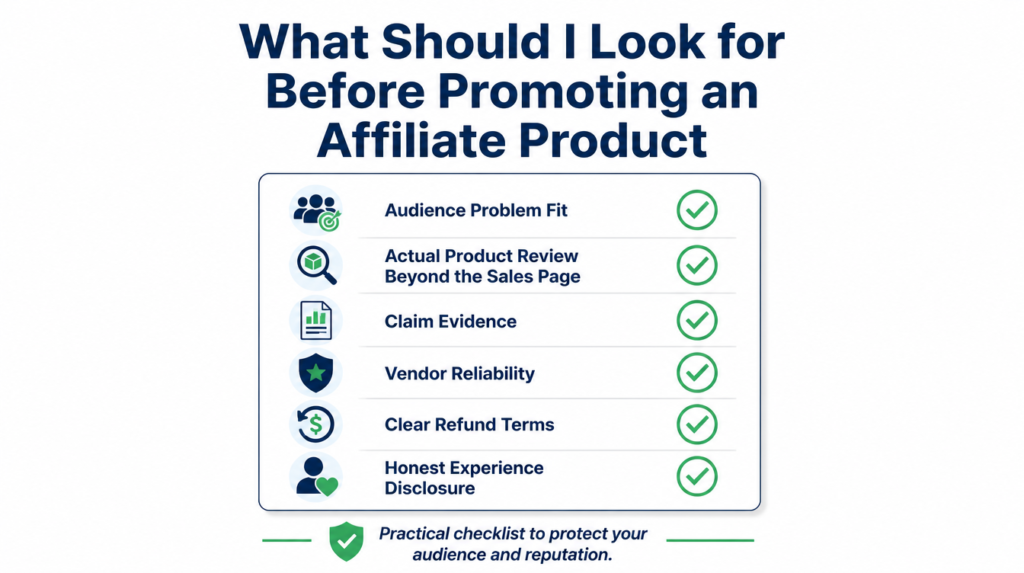
Answer: Before promoting an affiliate product, check whether it fits your audience, solves a real problem, delivers what it claims, comes from a reliable vendor, and creates a customer experience you are comfortable attaching your name to. You should also review the price, refund terms, support, commission structure, attribution rules, and any limitations buyers need to understand.
An affiliate program can look attractive from the outside because it offers a strong commission, a polished sales page, or a recognizable creator behind it. None of those things prove that the product deserves your recommendation.
The important question is not simply whether the offer can make sales. The question is whether you can responsibly place it in front of people who trust your judgment.
Begin With Audience Fit
The first thing to check is whether the product belongs in front of your audience at all.
A credible product can still be the wrong recommendation if it solves a problem your audience does not have, requires experience they have not developed, costs more than the problem feels worth, or introduces complexity when they need a simpler solution.
Before reviewing the commission or promotional materials, identify the specific audience problem the offer is supposed to solve. Then ask whether your readers, subscribers, or followers recognize that problem and are ready to address it now.
If you have to stretch the connection between the product and the audience, the fit is probably weak. A useful recommendation should feel like a logical next step, not a product searching for a reason to appear in your content.
For a deeper offer-fit test, read how to know if an affiliate offer is right for your audience.
Evaluate the Product, Not Just the Sales Page
A polished sales page can make an average product look exceptional. Before promoting anything, separate the marketing from the actual customer experience.
Review what the buyer receives, how the product is delivered, what is required to use it, and whether the features match the promises. If it is software, look at setup, usability, integrations, ongoing costs, and technical requirements. If it is a course or digital product, examine the depth, organization, support materials, and whether the content matches the stated skill level.
You should also look for the difference between what the product technically includes and what buyers are likely to accomplish with it. A product may contain many features while still being difficult to implement. A course may contain hours of content while leaving buyers without a clear path to apply it.
The product should not only look complete. It should help the right buyer move forward.
Verify the Main Claims
Every major promise should have some form of support behind it.
If the sales page claims the product saves time, improves conversions, simplifies a difficult process, or produces a particular result, look for evidence that makes the claim easier to inspect. This may include demonstrations, customer examples, case studies, screenshots, public reviews, documentation, or your own firsthand experience.
Be cautious when the proof is vague, overly polished, or disconnected from the claim. A collection of positive testimonials does not automatically prove that a product delivers the specific result being advertised.
You should also inspect the conditions behind any result. A buyer may need an existing audience, paid traffic, technical knowledge, additional software, or a significant amount of implementation time before the product becomes useful.
If the claim only works under conditions your audience does not have, the recommendation needs to say so.
Research the Vendor
The vendor controls much of the experience that follows your recommendation, so their reliability matters.
Look at how long the vendor or company has been operating, whether support appears responsive, how customers describe the product, and whether the business communicates clearly when problems occur. Search for patterns rather than reacting to one positive review or one angry complaint.
Pay particular attention to repeated concerns about billing, cancellations, product access, support delays, misleading claims, or refund disputes. These issues may become your problem indirectly because the buyer will remember who sent them to the offer.
A strong commission does not compensate for a vendor who treats customers poorly.
Review the Price and Total Commitment
The listed price may not represent the full cost of using the product.
Some offers require additional subscriptions, advertising spend, integrations, upgrades, training, or supporting tools. Others require a large time commitment before the buyer receives meaningful value.
Consider whether the total financial and practical commitment makes sense for the audience. A product may be affordable at checkout but expensive to implement. It may also appear simple while requiring more work than the buyer expects.
Your recommendation should help buyers understand the real commitment, not just the entry price.
Check Refunds, Guarantees, and Cancellation Terms
Before sending buyers to an offer, understand what happens if the product is not a fit.
Review the refund window, guarantee language, cancellation process, exclusions, recurring billing terms, and who handles customer requests. If the vendor controls refunds and support, make that responsibility clear in your content.
Do not describe an offer as risk free unless the actual terms support that language. A guarantee can reduce buyer hesitation, but vague or restrictive terms can create more confusion than confidence.
Clear terms protect the buyer and help you avoid making promises you do not control.
Inspect Customer Support and Product Access
Customer support often receives less attention than the commission or conversion rate, but it can determine whether the buyer has a good experience after the purchase.
Find out how customers receive help, whether support is provided by email, chat, a help center, a community, or another system, and how access problems are handled. For software and memberships, check whether cancellation and account management are straightforward.
If you offer an affiliate bonus, separate your responsibilities from the vendor’s responsibilities. The buyer should understand who delivers the product, who provides product support, and who fulfills any bonus connected to your recommendation.
Confusion after purchase can weaken trust even when the original recommendation was honest.
Understand the Affiliate Program
The product and the affiliate program should be evaluated separately.
A good product may have a weak affiliate program. A commercially attractive affiliate program may be attached to a product you should not recommend.
Review the commission rate, payment schedule, minimum payout, cookie duration, attribution model, refund deductions, tracking dashboard, prohibited traffic sources, and rules around email, paid ads, social media, or branded keywords.
You should also understand what happens when another affiliate, coupon site, browser extension, or vendor email enters the customer journey. A high commission means little if the program does not track referrals reliably or if attribution can easily be overwritten.
The affiliate program determines whether the promotion works for your business. The product determines whether the recommendation works for the buyer. Both need to make sense.
Be Honest About Your Level of Experience
Firsthand use can strengthen a recommendation, but not every useful affiliate article requires personal ownership of the product.
If you have used the product, explain what you used, what happened, what worked, and what limitations you noticed. Avoid turning limited experience into a broad claim about every buyer or use case.
If the recommendation is based on research rather than firsthand use, say so. You can still evaluate documentation, features, pricing, customer feedback, vendor history, and how the offer compares with alternatives.
The problem is not researched content. The problem is presenting research as personal experience or making claims that cannot be supported.
Clear boundaries make recommendations more credible.
Consider the Risk to Your Reputation
Every affiliate recommendation is also a judgment call that becomes part of your brand.
The buyer may complete the purchase on the vendor’s site, but they arrived because you directed them there. If the product is misleading, difficult to use, poorly supported, or wrong for the audience, that experience can change how the buyer views your future recommendations.
This is why affiliate offers should not be treated as interchangeable links. Each one spends some of the trust you have built with the audience.
Before promoting the product, ask whether you would feel comfortable explaining the recommendation directly to a buyer who had a bad experience. If the answer is no, the offer probably needs more investigation.
Use This Pre-Promotion Checklist
Before publishing the recommendation, confirm that you can answer these questions:
- What specific audience problem does the product solve?
- Is the audience ready to use the product now?
- Have I evaluated the actual product rather than only the sales page?
- Are the main claims supported by proof?
- What experience, tools, time, or additional costs are required?
- Is the vendor reliable and responsive?
- Are the price, billing, refund, and cancellation terms clear?
- Who handles product delivery, refunds, and customer support?
- Is my recommendation based on firsthand use, research, or both?
- Does the affiliate program track and pay referrals reliably?
- Can I explain who the product is not for?
- Would I still recommend it if the commission were lower?
If several answers remain unclear, delay the promotion until you have enough information to make a responsible recommendation.
Bottom Line
Before promoting an affiliate product, evaluate the entire decision path, not just the payout.
The offer should fit the audience, the product should support its claims, the vendor should treat customers well, and the terms should be clear. You should understand what the buyer receives, what it takes to use the product, who handles problems, and how the affiliate program tracks your referral.
A strong affiliate recommendation is not the product with the most exciting sales page or the highest commission. It is the product you can recommend with clear reasoning, realistic expectations, and confidence in what happens after the buyer clicks.
Browse more affiliate marketing questions and answers.
For the larger framework behind offer selection, buyer trust, incentives, and recommendation quality, read Affiliate Marketing Decision Systems.
For a deeper look at proof, support, disclosure, and accountability, visit Trust Infrastructure for Affiliate Marketing.