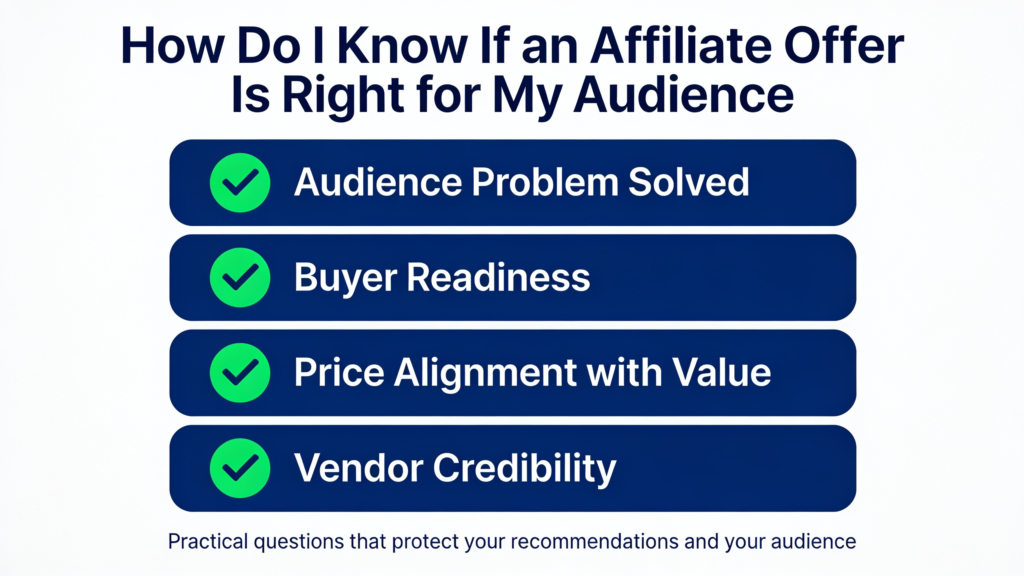
A good product is not automatically a good offer for every audience. It may be well designed, fairly priced, and supported by a reputable company, but still fail if it does not match what your readers, subscribers, or followers need right now.
This is why affiliate offer selection should begin with the audience rather than the affiliate program.
Start With the Problem Your Audience Already Recognizes
The first question is not whether the product has impressive features. The first question is whether it solves a problem your audience already understands and wants to address.
If your audience is trying to publish content more consistently, an offer that helps organize, create, or distribute content may fit naturally. An advanced analytics platform may still be useful, but it could be too far removed from the problem they are currently trying to solve.
People are more likely to consider an offer when they can quickly understand how it connects to something they already care about. If you have to spend most of the article convincing them that the problem exists before you can explain the product, the offer may be too early for that audience.
Match the Offer to Buyer Readiness
Audience fit also depends on readiness.
Two people can have the same general problem but need very different solutions. A beginner may need a simple checklist, template, or low-cost tool. Someone with more experience may be ready for advanced software, a detailed course, or a higher-priced service.
An offer can fail because it is too advanced, too basic, too expensive, or too demanding for the buyer’s current situation. That does not mean the product is bad. It means the timing is wrong.
Before promoting an offer, ask whether your audience can realistically use it now. Consider the experience, time, money, tools, and commitment required to get value from it.
Check Whether the Price Matches the Problem
The offer’s price should make sense in relation to the problem it solves and the audience you serve.
A high-priced product may be justified when it solves an expensive or urgent problem. The same price may feel unreasonable when the outcome is minor, uncertain, or available through simpler alternatives.
This does not mean you should only promote inexpensive products. It means the value, price, and buyer expectation should match.
If your audience usually purchases small digital products, suddenly recommending an expensive program requires more explanation, proof, and trust. The larger the commitment, the stronger the recommendation and supporting evidence need to be.
Separate Product Quality From Audience Fit
Product quality and audience fit are related, but they are not the same.
A product can be excellent and still be wrong for your audience. It may solve a different problem, require skills they do not have, or deliver more complexity than they need.
The reverse is also important. A product may appear to match the audience but still be poorly supported, misleading, difficult to use, or attached to an unreliable vendor. Audience relevance does not excuse weak product quality.
A strong affiliate recommendation requires both. The product should be credible, and the audience should have a clear reason to use it.
Consider Why Your Audience Trusts You
The offer should also fit the context of your relationship with the audience.
If people follow you for simple content systems, a recommendation for a practical content tool may feel natural. A sudden promotion for an unrelated financial product may feel disconnected, even if the commission is attractive.
Every recommendation teaches the audience something about your judgment. When the offer fits the subjects you discuss and the problems you regularly help solve, the recommendation feels like a continuation of your work.
When the connection feels forced, the audience notices.
Look Beyond the Commission Rate
A high commission does not make an offer a good fit.
Commission rates can influence which products affiliates notice, but they should not determine which products the audience sees. An offer with a smaller commission may be the better recommendation if it solves the problem more clearly, has stronger support, and creates a better customer experience.
You should also inspect the vendor, refund policy, product delivery, customer support, and reputation. The buyer may purchase from the vendor, but their experience can still affect how they view your recommendation.
The commission is part of the business decision. It should not become the reason the offer is presented as the best solution.
Use a Simple Offer-Fit Test
Before promoting an affiliate offer, ask:
- Does this solve a problem my audience already recognizes?
- Is my audience ready to use this product now?
- Does the price match the value and urgency of the problem?
- Is the product credible and supported by a reliable vendor?
- Can I explain why this offer fits without stretching the connection?
- Would I still recommend it if the commission were lower?
- Can I clearly explain who the offer is not for?
If several answers are unclear, the offer probably needs more evaluation before it deserves promotion.
Bottom Line
An affiliate offer is right for your audience when the product, problem, buyer readiness, price, timing, and recommendation context all fit together.
The best offer is not automatically the most popular product or the one with the highest commission. It is the offer you can connect to a real audience need, support with honest reasoning, and recommend without asking the buyer to force the fit.
Start with the audience problem. Then evaluate the product. The commission comes after both.
Browse more affiliate marketing questions and answers.
For the larger framework behind offer selection, buyer decisions, incentives, and recommendation quality, read Affiliate Marketing Decision Systems.