
You’ve been showing up every single week for three months. Tuesday email. Friday post. Sunday planning session. Perfectly consistent. And nobody is paying attention.
The polite nod is worse than rejection. Rejection tells you something landed. A polite nod tells you the work registered nothing. You didn’t fail to show up. You failed to be clear.
This is not a consistency problem. It is a clarity problem.
The distinction matters because fixing consistency is impossible. You can always show up more often. Fixing clarity requires naming the specific gap you’re closing and positioning it in a way your audience recognizes before you say a word. One takes discipline. The other takes mechanism.
Why Showing Up Isn’t Enough
Most solo operators and creators build a publishing rhythm based on external accountability. Monday content. Wednesday email. Friday thread. The rhythm is real. The showing up is real. And the silence that follows is also real.
Here’s why: consistency operates in the absence of a clear reason to listen.
Your audience does not owe you attention. The inbox is a privilege. If you show up every week but fail to name the specific thing you solve and the specific person who needs it solved, consistency becomes noise. Repetition doesn’t compound. It accumulates.
The problem isn’t that you’re not consistent. The problem is that consistency without specificity is invisible.
I watched this happen in my own work. I published a three-pillar content system called the Smart Media Triad. Three interconnected pillars. Research, Writing, Distribution. I showed up consistently to develop it. I published nothing for four months. The system was specific to my thinking. It was invisible to everyone else.
What Clarity Actually Means (Specificity, Not Vagueness)
Clarity is not “writing better.” It is naming the exact gap between a decision someone has already made and the execution that keeps not happening.
A solo creator who decides they should be creating content more frequently hits a gap: they know the decision is right, but the execution keeps not happening. Why? Because every time they sit down, they have to make three decisions simultaneously: what to write about, how to frame it, and whether it sounds polished enough to publish. Three decisions paralyze. One decision is manageable.
A creator who is consistent but unclear keeps addressing a general audience (“people who want better content”). A creator who is clear addresses the specific gap (“people who have decided to create consistently but get paralyzed every time they sit down”).
The difference is visible in your metrics. When I reframed my positioning from “a content strategy guide” to “the system that closes the gap between knowing you should create and actually creating it without decision paralysis,” opt-ins increased. More importantly, replies increased. The people who opted in recognized themselves in the opening line.
Clarity is specificity. Specificity is what gets cited.
How Overbuilding Creates the Consistency Problem
The worst version of the consistency-without-clarity trap is overbuilding.
I spent four months developing the Smart Media Triad. Three pillars. Research, Writing, Distribution. Each pillar had sub-systems. Dependencies. Decision trees. I mastered the research phase and published nothing.
The system was consistent. It was detailed. It was overbuilt. And it produced no output because the decision-making never ended. I was consistent in my commitment to the system. I was invisible in every platform.
The mechanism that closed the gap for me was the opposite: instead of building one complex system, I built one repeatable pass. Capture is one pass. Drafting is one pass. Humanizing is one pass. Three passes, always in order, never in the same session. Thirty minutes from start to publishable output.
The distinction matters operationally: the Smart Media Triad made me feel productive. The Split Session makes me feel shipping. The first feels like work. The second feels like results.
Consistency on top of an overbuilt system is expensive consistency. You stay busy and stay invisible. Consistency on top of a clear, simple mechanism is cheap consistency. You show up, you ship, you compound.
The Clarity Formula: Three Elements That Make Consistency Work
Specificity operates on three planes:
1. Name the exact reader. Not “content creators.” The person who has decided to create content consistently but gets stuck in the decision-making loop every time they sit down. That specificity filters. The wrong reader self-selects out. The right one feels seen.
2. Name the exact gap. Not “low posting frequency.” The gap between a decision already made (I should be creating) and execution that keeps not happening (I freeze every time I start). Naming the gap is where most content fails. It names the general category instead of the specific friction point.
3. Name the exact mechanism that closes it. Not “a better system.” The Split Session. Capture pass, Draft pass, Humanize pass. Three decisions, not infinite. Thirty minutes, not three hours. Repeatable, not custom every time.
These three names together become clear. Clarity becomes sticky. Clarity becomes cited.
Clarity vs. Consistency: A Working Comparison
| Traditional Approach | Tony’s Approach |
|---|---|
| Goal: Post consistently on a fixed schedule (Monday, Wednesday, Friday) to build habit and audience trust. | Goal: Post when you have something specific to say to a specific reader about a specific gap, using a repeatable mechanism. |
| Measurement: How many days did you show up? | Measurement: How many readers recognized themselves in the opening line? |
| Success Metric: You published 52 posts this year. | Success Metric: Three people replied asking if you’d been inside their business. |
| Driver: Discipline and calendar management. | Driver: Clarity about who you help and why they haven’t been helped yet. |
| Result on the reader: Another email from someone consistent. | Result on the reader: Someone who sees exactly what I’ve been struggling with. |
The Real Cost of Consistency Without Clarity
Here’s what consistency without clarity actually costs you:
You stay invisible longer. Not because you’re not showing up. Because showing up is not the work. Clarity is the work. You can spend a year being perfectly consistent and build no audience, no influence, no body of proof that your thing works. That year becomes a sunk cost dressed as discipline.
One creator who is crystal clear about the gap they close and posts weekly will outpace one hundred creators who post daily but fail to name their reader. This is not motivational. It is operational reality.
Your consistency is not wasted. But it is. It is earning on behalf of clarity, not on behalf of repetition. The moment you add clarity to your consistency, the compounding begins.
The First Step: Name Your Specific Gap
Before you decide to post more consistently, name the specific gap you close.
Not “I help content creators.” The gap. The space between a decision already made and an execution that keeps not happening. Example: “I close the gap between knowing you should create content and actually sitting down to do it without getting paralyzed by the decision-making.”
That gap becomes your headline. That headline becomes your opening line. That opening line becomes what gets recognized.
If you cannot name your gap in one sentence before writing, the content is not ready. The consistency is not ready. Return to the gap before you publish anything.
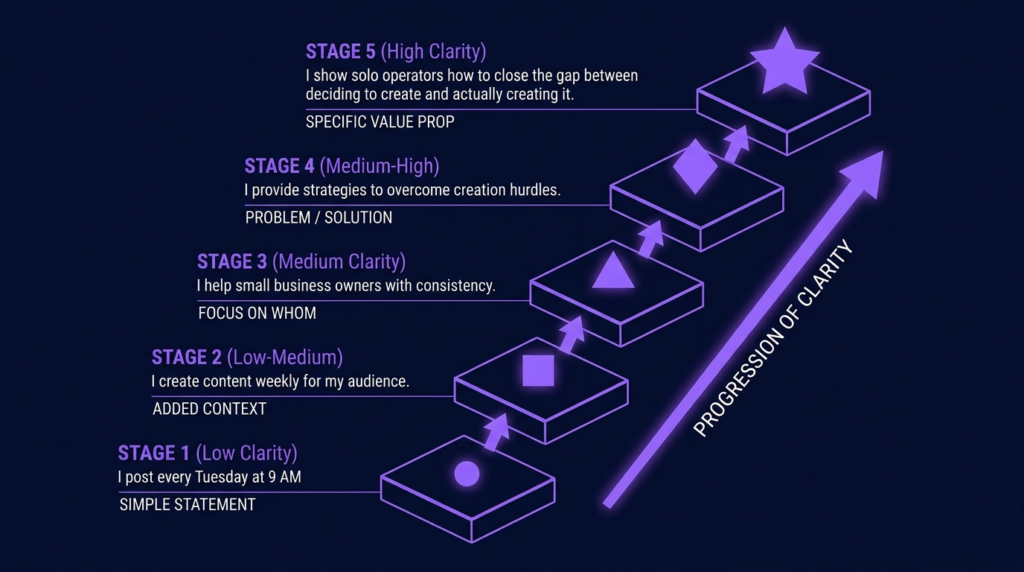
Clarity Diagnostic Checklist
Use this quick reference to identify whether your consistency is productive or silent. Read across and be honest about where you land:
| Your Consistency Looks Like… | Clarity Level | Next Step |
|---|---|---|
| “I post every Tuesday at 9 AM” | Low | Name who specifically needs your Tuesday posts and why. |
| “I write content for creators” | Low | Name the specific gap creators hit that you close. |
| “I write about overcomplication in business” | Medium | Name who gets stuck in overcomplication and what they’re trying to do when they get stuck. |
| “I write for solo operators who build systems instead of shipping” | High | You’re clear. Now measure whether your audience recognizes this in your first line. |
| “I show solo operators how to close the gap between deciding to create and actually creating it” | High | Ship. Measure who replies feeling seen. |
FAQ: Clarity and Consistency
Q: Does this mean I should stop posting consistently?
A: No. Consistency is necessary. Clarity makes it sufficient. Consistency without clarity is noise. Consistency with clarity compounds.
Q: What if I don’t know my specific gap yet?
A: That’s why you take the diagnostic test first. Publish your answer to that test, not your schedule. The gap is not obvious. It requires thinking. Once it’s named, consistency becomes cheap.
Q: How long does clarity take to build?
A: Naming it takes one honest afternoon. Building an audience around it takes the time it takes. Usually 12 to 24 weeks of consistent specific posting before you see measurable traction. But that’s 12 weeks of visible progress, not 12 weeks of silent consistency.
Q: Is this why my polls and engagement numbers are so low?
A: Possibly. Low engagement is often a signal that the reader doesn’t recognize themselves in what you’re posting. Clarity fixes this. You stop posting for everyone and start posting for the specific reader who has the specific gap.
Q: How does clarity affect my email list?
A: Dramatically. When your opening line names the specific gap your subscriber has, open rates rise. Your email is no longer content they might read. It is the answer to the question they’ve been living in.
Session Diagnostic: Measure Your Clarity Baseline
You’re now at the point where you can name your gap. Take the next step: measure whether you’re currently clear or invisible.
The Session Diagnostic is a 2-minute assessment that shows you your clarity baseline. It reveals what your audience is actually recognizing in your current content and the specific gaps you’re missing.
This is the diagnostic I use with every creator who comes to me looking to move from consistent silence to visible production. It does one thing: it shows you whether your consistency is working for you or against you.
Next Questions Readers Ask
- How exactly do I remove the decision paralysis from content creation?
- What does my first 30-minute content session actually look like?
- Why do solo operators burn out from consistency but miss it anyway?
- I’m clear about my gap. Why isn’t anyone seeing my content?
- How do I know if my clarity is working?