
You open a blank document. The cursor is blinking. And you freeze.
Not because you don’t have ideas. Not because you lack motivation. You freeze because the moment you sit down to write, you’re asked to make three decisions at the same time.
What should I write about? How should I frame it? Is this polished enough to publish?
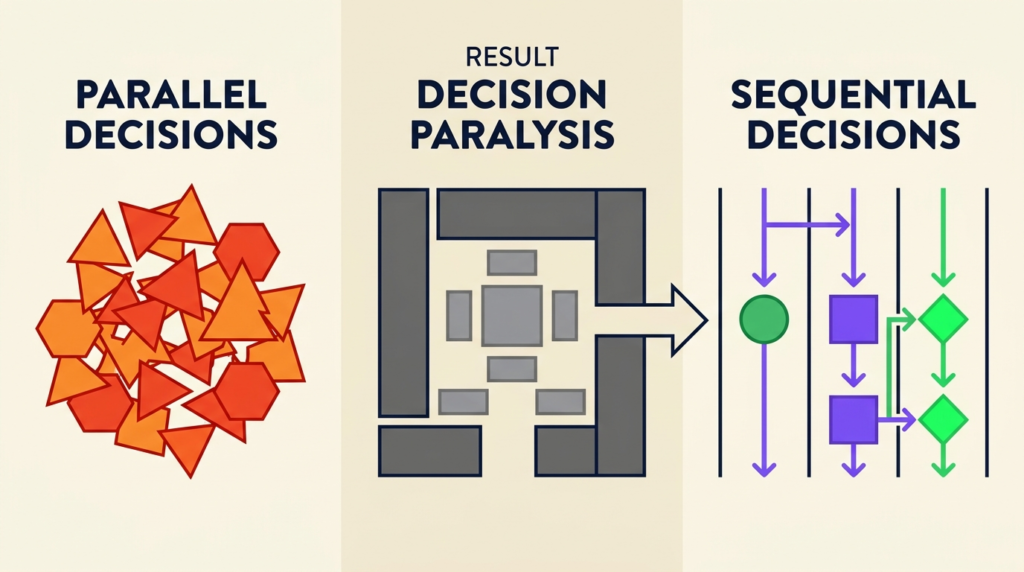
Three simultaneous decisions. Your brain cannot process them in parallel. So nothing comes out.
This is not a procrastination problem. This is not a willpower problem. This is a system problem. And like all system problems, it has a specific solution.
The Three Decisions That Lock You Up
Every time you sit down to create, you face three separate decisions that feel like one impossible decision.
Decision 1: What should I write about?
Not “what topic.” What specific thing. Specific enough that someone could implement it. Specific enough that a reader recognizes themselves. You’re not just picking a topic. You’re picking an angle on that topic. And the angle matters more than the topic itself.
Most creators skip this step. They sit down with “content creation” in mind. That’s not specific enough. Your brain knows it. So you stare at the cursor.
Decision 2: How should I frame it?
Once you know what you’re writing about, you have to decide how to position it. For who? With what emotional landing? As a warning or an opportunity? As a story or a system? The frame determines whether the reader feels seen or lectured.
This is where most creators get trapped. They’re still thinking about the topic when they should be thinking about the audience. The topic and the frame are different decisions. But most people try to solve them simultaneously. The cursor keeps blinking.
Decision 3: Is this polished enough to publish?
Before you hit send, you have to make a judgment call. Is this good enough? Should it be edited? Is the writing polished? Do I sound confident? Do I sound too confident? Are there any weak lines?
This decision never ends. You can always refine. So you refine. And refine. And the post never ships.
Here’s what makes these three decisions particularly paralyzing: you’re making them all at once. While you’re still drafting decision 1, your brain is already worried about decision 3. You write a sentence and immediately judge whether it’s polished enough. You stop writing. You edit. You get stuck. The cursor blinks again.
Why Three Simultaneous Decisions Destroy Output
A solo creator can handle one hard decision. Make a choice. Commit. Move forward. But three decisions happening in the same moment? Your brain chooses the safest option: freeze.
Late at night, I learned this the hard way. Three monitors. A notebook full of system notes. A blank document on the screen. Dead screen glow, the only light in the room. I would sit down to write and immediately get stuck in the decision triage.
What angle should this take? I still don’t know. Should I edit this sentence? Probably. Is this worth publishing? Not sure yet. So I stay there, cursor blinking, making no progress.
The paralysis looks like overthinking. It feels like perfectionism. But it’s actually a decision-making traffic jam. Three decisions queued up at the same time, with no clear priority.
I confused the map for the territory. The system was not the work. The work was the work. But I kept trying to perfect the system while the system sat on my desk, incomplete, for months.
The Cost of Never Resolving These Three Decisions
When you never resolve these three decisions, something specific happens: you don’t publish.
Not because you’re lazy. Not because the work isn’t good. Because the moment you sit down, all three questions hit you at once, and your brain finds it easier to close the document than to answer all three simultaneously.
One week of this. No output.
Four weeks of this. No output.
Three months of this. No output.
You’re still committed to the process. You still believe in the work. But nothing ships because the decisions never separate. They stay tangled. And tangled decisions don’t produce content.
The real cost is compounding. Every week you don’t ship is a week the audience doesn’t see you. Every month is a month the network effects don’t build. Six months of decision paralysis means six months of progress you could have made but didn’t. That’s not a missed week. That’s a missed compounding cycle.
This Is a System Problem, Not a Willpower Problem
Here’s what makes this tricky: it feels like a willpower problem. You tell yourself “I just need to be more disciplined. I just need to sit down and push through.”
But discipline doesn’t solve a system problem. You can force yourself to sit down. You still face three simultaneous decisions. The paralysis returns.
Fear dressed as strategy looks like research. You tell yourself “I need to think more about what angle to take.” So you research. You gather more information. You tell yourself you’re making progress. But what you’re really doing is delaying the moment when you have to commit to one of the three decisions.
This pattern repeats. You research. You gather notes. You add more structure to the system. You feel productive. You ship nothing.
The system I built—the Smart Media Triad—was a perfect example of this. It looked rigorous. It looked professional. It made me feel like I was making progress. I was adding layers. Each layer felt like it was bringing me closer to the answer. But the truth was simpler: the system was so complex that by the time I understood all three pillars, I had no energy left to write.
Complexity creates more decisions. More decisions create more paralysis. More paralysis means more content never ships.
The Pattern Most Creators Don’t See
You can break down this paralysis into a clear pattern that most solo creators live inside without naming it.
Week 1: You want to write. You sit down. Three decisions hit at once. You get stuck. You tell yourself “I need to think about this more.”
Week 2: You’ve thought about it. You sit down again. Same three decisions. Same paralysis. Now you tell yourself “Maybe I need a better system.”
Week 3: You build a better system. Or you find a framework. Or you buy a course. The new system has clarity about the angle. So you feel like progress is being made. You haven’t written anything yet, but you feel productive.
Week 4: You publish. It feels good. Relief. But the next week, the three decisions hit again. And the cycle restarts.
This cycle is what most creators call “consistency.” But it’s not consistency. It’s cycling. You cycle between paralysis, system-building, and occasional output. Nothing compounds.
The difference between cycling and consistency is decision-making clarity. If you could resolve the three decisions separately—one at a time, in order—then every time you sit down would produce output. The cycle would break.
Why the Decision Paralysis Reveals Everything
Decision paralysis is a teaching moment, not a failure moment.
When you notice you’re frozen, staring at a blank cursor, you now know what’s happening: three decisions are queued up and trying to process simultaneously. Your brain is asking you to be a topic generator, a positioning strategist, and a quality control manager all at the same time.
That’s not a personal failing. That’s a system design problem.
And system problems have system solutions. Not willpower solutions. Not more research. Not a better framework. A different structure. One that separates the three decisions so you’re only making one decision at a time.
This is where most content creation systems fail. They assume you can handle all three decisions simultaneously. They don’t. So you don’t ship.
A system that works would let you make decision 1 without worrying about decision 3. Then move to decision 2. Then decision 3. Three sequential decisions, not three parallel ones. Your brain can handle that.
The moment you separate the decisions, the paralysis dissolves.
Decision Paralysis Diagnostic
Use this to identify which of the three decisions is blocking you most:
| Decision | Symptom | What You’re Actually Stuck On |
|---|---|---|
| What to write about | You have ideas but can’t pick one. You start writing, then switch topics mid-draft. | You’re trying to be specific but the specificity feels too narrow. You’re afraid of leaving out other ideas. |
| How to frame it | You know what to write but don’t know who it’s for. You write one version, then rewrite it five times for different audiences. | You’re trying to speak to multiple readers at once. You’re hedging your positioning instead of committing to one. |
| Whether it’s polished enough | You get close to publishing. Then you edit. Then you re-edit. The post sits in draft for weeks. You never hit send. | You don’t have a publication standard. Every sentence feels negotiable. You’re trying to make it perfect instead of good enough. |
Which one is you? That’s the decision that’s paralyzing you. And that’s the one a better system needs to solve first.
FAQ: The Decision Paralysis Question
Q: If I solve one decision, won’t the other two still paralyze me?
A: Not if you solve them in sequence, not in parallel. The goal is not to solve all three at once. The goal is to make them sequential. Decision 1, then decision 2, then decision 3. By the time you hit decision 3, you’ve already committed to decisions 1 and 2. No backtracking. The paralysis breaks.
Q: What if I don’t know what to write about until I start writing?
A: That’s decision 1 not being clear before you start. Most creators work this way. You sit down and discover the topic as you write. But that’s discovery happening in real-time, while you’re also trying to handle decisions 2 and 3. It overloads the system. The better approach: do decision 1 before you open the document. Decide what you’re writing. Then open the document with that decision already made.
Q: How do I know if I’m overthinking or if I’m being genuinely careful?
A: Genuinely careful means you have a standard and you’re checking against it. Overthinking means you keep changing the standard. If you’re rewriting the same sentence ten times, you’ve moved from careful to overthinking. Careful has a finish line. Overthinking doesn’t.
Q: Doesn’t this paralysis just mean I’m not ready to publish?
A: No. It means the decisions are structured in a way that overloads your brain. You’re ready to publish. The readiness is not the problem. The decision architecture is the problem. Fix the architecture, and readiness becomes irrelevant.
Q: What if I’m afraid of publishing something bad?
A: Fear dressed as strategy looks like research. You’re gathering more information, building more systems, waiting for more clarity. But the fear is not about the content. It’s about whether you’re good enough. That’s a different problem than decision paralysis. Though they often happen together. The decision paralysis keeps you from testing your fear. And the fear keeps you stuck in decision paralysis.
Three-Decision Framework Checklist
Before you sit down to write, make these three decisions in advance. Write them down. Then open the document.
Decision 1: What am I writing about? (One sentence. Specific enough that someone could implement it. Example: “The three decisions that paralyze creators every time they sit down to write.”)
Decision 2: Who am I writing this for, and why? (One sentence. The specific reader. The gap they have. Example: “The solo creator who has ideas but freezes before publishing because three decisions hit at once.”)
Decision 3: What’s my publication standard? (One sentence. Not perfection. A clear enough finish line. Example: “Good enough when it’s specific, honest, and someone could take one action from it.”)
Write these down. Now open the document. Now the three decisions are already made. Your job is not to decide. Your job is to execute against decisions you already made.
The Cost of Unresolved Decisions Over Time
One month of monthly paralysis: 4 unpublished pieces.
Three months: 12 unpublished pieces.
One year: 52 unpublished pieces that never built audience, never generated replies, never created compounding.
A solo creator who publishes 12 pieces per year that are clear and specific will outpace a creator who publishes 52 pieces per year but paralyzes on every single one and publishes half of them.
The difference is not the number. The difference is decision clarity. Resolved decisions ship content. Unresolved decisions cycle.
Session Diagnostic: Measure Your Paralysis Pattern
The Session Diagnostic is built to identify which of the three decisions is blocking you and show you the pattern.
You answer nine questions about your current writing sessions. The diagnostic returns a paralysis profile: are you stuck on topic (decision 1), positioning (decision 2), or publication standards (decision 3)?
Then it shows you the mechanism designed specifically to resolve that decision first.
Most creators discover they’re stuck on the same decision every single time. Not stuck in general. Stuck in a specific place. Once you know where you’re stuck, the solution becomes obvious.
Next Questions Readers Ask
- How exactly do I remove the decision paralysis from content creation?
- Why does showing up consistently not result in content production?
- What does my first 30-minute content session actually look like?
- Why do solo operators burn out from consistency but miss it anyway?
- I’m clear about my gap. Why isn’t anyone seeing my content?